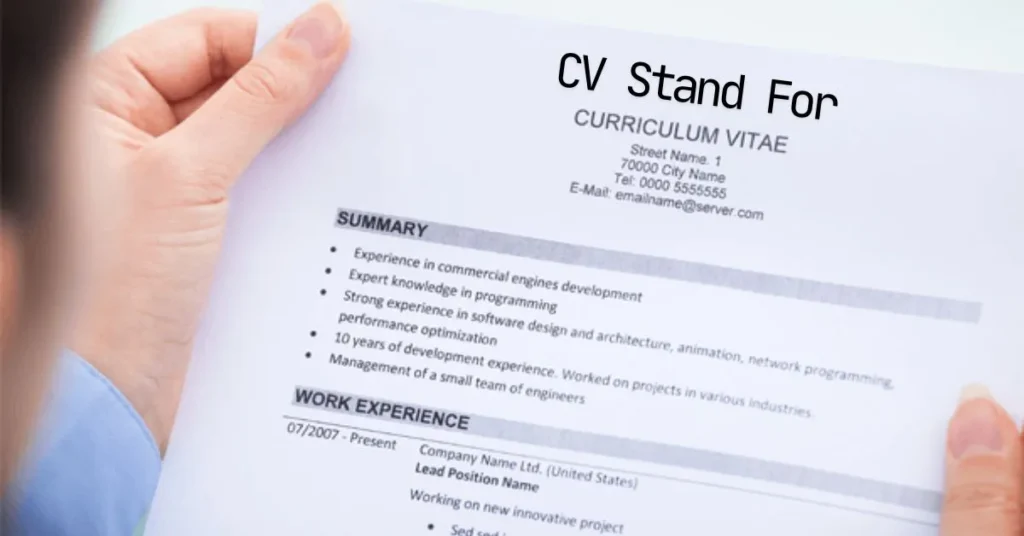
A CV, short for Curriculum Vitae, is more than just a document it’s a detailed record of your professional and academic journey.
Many people often confuse a CV with a resume, but while both serve to showcase your skills and experience, a CV provides a more comprehensive overview of your education, achievements, and career milestones.
Understanding what a CV stands for and how to create one is essential for students, job seekers, and professionals looking to advance their careers.
Whether you are applying for a corporate role, an academic position, or a research opportunity, a well-structured CV can make all the difference in catching the attention of employers or admissions committees.
In this guide, we’ll explore the meaning of CV, its key components, differences from a resume, and tips to craft an effective CV that stands out in today’s competitive job market.
Definition of CV
The term CV stands for Curriculum Vitae, which is Latin for “course of life.” Essentially, a CV is a detailed document that outlines an individual’s professional, academic, and personal achievements throughout their career or education. Unlike a resume, which is often concise and tailored for a specific job, a CV provides a comprehensive record of your educational background, work experience, skills, accomplishments, and other relevant information.
A CV is widely used in academia, research, medicine, and international job applications, as it gives employers, institutions, or admissions committees a full picture of an applicant’s qualifications and expertise. While the term CV is commonly used in countries like the UK, Europe, and Asia, in the United States, the term is often associated with academic or research applications rather than standard job applications.
The importance of understanding what a CV stands for goes beyond terminology. It helps you structure your professional information effectively and highlight key achievements that make you stand out. By knowing the definition and purpose of a CV, you can create a document that not only showcases your skills and experience but also reflects your professional identity.
A well-crafted CV serves as a roadmap of your career, making it easier for potential employers or institutions to assess your qualifications at a glance. In the next section, we’ll explore the essential components of a CV that every applicant should include.
Components of a CV
A well-structured CV is composed of several key components that collectively showcase your qualifications, experience, and skills. Understanding what to include and how to organize each section is crucial for creating a professional CV that captures attention.
1. Personal Information: This section includes your full name, contact details such as phone number and email, and optionally, links to professional profiles like LinkedIn or personal websites. Avoid unnecessary personal details like age or marital status unless specifically requested.
2. Professional Summary or Objective: A brief statement summarizing your career goals, areas of expertise, and value to potential employers. This sets the tone of your CV and gives a snapshot of your professional identity.
3. Education and Qualifications: List your academic background in reverse chronological order, including degrees, institutions, and graduation dates. Relevant certifications or training programs should also be included here.
4. Work Experience: Outline your professional history, focusing on roles, responsibilities, achievements, and measurable results. Use action verbs and concise descriptions to highlight your impact in each position.
5. Skills: Include both hard skills (technical abilities) and soft skills (communication, leadership, problem-solving) relevant to the role you are targeting.
6. Additional Sections: Depending on your field, you may include awards, honors, publications, volunteer work, or projects. References can be listed or noted as “available upon request.”
By carefully organizing these components, your CV becomes a clear, professional representation of your career journey, making it easier for employers or institutions to evaluate your qualifications.
CV vs Resume – Key Differences
Many people confuse a CV (Curriculum Vitae) with a resume, but understanding the differences is essential for presenting your professional profile effectively. While both documents highlight your skills, education, and experience, they serve different purposes and are used in different contexts.
1. Length and Detail: A CV is comprehensive and detailed, often spanning multiple pages to cover your entire career, academic achievements, publications, and awards. In contrast, a resume is concise, usually limited to one or two pages, and tailored specifically for the job you are applying for.
2. Purpose and Usage: CVs are commonly used in academia, research, medicine, and international job applications. They provide a complete overview of your professional and educational history. Resumes, on the other hand, are standard in corporate and private sectors, emphasizing skills and achievements relevant to a specific role.
3. Regional Differences: In the United States, “resume” is the more common term for job applications, while CVs are mainly used for academic, scientific, or research positions. In Europe, Asia, and the UK, “CV” is the standard term for most professional applications.
4. Content and Flexibility: CVs include extensive details such as publications, projects, and references. Resumes focus on job-specific skills and accomplishments, often omitting less relevant information.
Understanding these differences ensures that you choose the right document for your application, whether you are applying for a corporate position, research role, or academic opportunity. Crafting the appropriate document increases your chances of standing out to employers or admissions committees.
How to Write an Effective CV
Writing an effective CV requires more than simply listing your education and work experience. It’s about presenting your qualifications and achievements in a clear, organized, and compelling way that captures the attention of employers or admissions committees.
1. Start with a Strong Professional Summary: Begin your CV with a concise professional summary or career objective. Highlight your key skills, experience, and what you can contribute to a potential employer. This sets the tone for the rest of your CV.
2. Organize Sections Clearly: Use headings and subheadings to separate sections like Education, Work Experience, Skills, and Achievements. A well-structured layout ensures that your CV is easy to read and allows recruiters to quickly find relevant information.
3. Tailor Your CV to the Role: Customize your CV for each job application. Focus on skills, experience, and achievements that align with the specific requirements of the role. Avoid including irrelevant information that doesn’t strengthen your application.
4. Use Action-Oriented Language: Describe your work experience and accomplishments using strong action verbs, such as “managed,” “developed,” or “implemented.” Whenever possible, include measurable results to demonstrate your impact.
5. Keep it Professional and Error-Free: Use a clean, professional format and avoid excessive colors or fonts. Proofread carefully to eliminate grammatical errors, typos, and inconsistencies.
6. Highlight Achievements, Not Just Duties: Employers are more interested in what you accomplished rather than what you were assigned. Emphasize contributions that made a tangible difference.
By following these steps, you can create a CV that is not only informative but also persuasive, increasing your chances of landing interviews and advancing your career.
Examples of CVs
Understanding what a CV looks like in practice can help you create a professional and effective document. While CVs can vary depending on your career stage or industry, there are common examples that serve as useful templates.
1. Student CV: For students or recent graduates, a CV focuses on education, internships, projects, and relevant skills. Since work experience may be limited, highlight academic achievements, volunteer work, and extracurricular activities. Including a professional summary emphasizing learning, adaptability, and career goals can make a student CV stand out.
2. Professional CV: Professionals with work experience should focus on showcasing roles, responsibilities, and measurable accomplishments. Each job should list key contributions and results. Skills and certifications relevant to the industry should also be included. This type of CV is ideal for corporate jobs, managerial positions, and specialized roles.
3. Academic or Research CV: Used primarily in academia, research, or scientific fields, this CV emphasizes education, publications, research projects, conferences, teaching experience, and awards. It may be several pages long to fully detail scholarly achievements and professional contributions.
Tips for All CV Examples: Regardless of the type, clarity, organization, and professionalism are essential. Use bullet points, reverse chronological order, and concise language. Ensure your contact information and professional summary are visible at the top.
By reviewing examples of different CV types, you can adapt your own CV to suit your career goals, highlighting your strengths and presenting your experience in the most effective way possible.
Other Meanings of CV
While CV most commonly refers to Curriculum Vitae, the abbreviation can have several other meanings depending on the context. Understanding these alternative uses can help avoid confusion, especially in technical, financial, or engineering fields.
1. Finance – Coefficient of Variation: In finance and statistics, CV stands for Coefficient of Variation, a measure of relative variability. It compares the standard deviation of a dataset to its mean, helping investors or analysts understand the level of risk or volatility associated with investments, returns, or financial data.
2. Automotive / Engineering – Constant Velocity: In the automotive and engineering world, CV often refers to Constant Velocity joints. These are components in a vehicle’s drivetrain that allow the wheels to receive power smoothly while turning or moving over uneven surfaces. CV joints are critical for efficient and safe vehicle operation.
3. Medicine / Science: In clinical or research contexts, CV can sometimes refer to Curriculum Vitae specifically in medical, scientific, or laboratory settings. It may also appear in abbreviations like Cardiovascular (CV) health, which relates to the heart and blood vessels.
4. Miscellaneous Uses: In some technical documents, CV may refer to Control Valve, Commercial Vehicle, or other niche industry terms. Context is always key to understanding the correct meaning.
Knowing that CV has multiple interpretations ensures you correctly understand its intended use. However, in professional, academic, and job application settings, Curriculum Vitae remains the most widely recognized meaning of CV worldwide.
Frequently Asked Questions (FAQs) About CV
1. How long should a CV be?
A CV is typically longer than a resume and can range from two to several pages, depending on your experience. Academic or research CVs may be particularly long due to publications, projects, and detailed work history. The key is to include relevant information without overwhelming the reader.
2. Can a CV include a photo?
Including a photo depends on regional norms and the type of position. In some countries like the UK or US, it is generally discouraged unless explicitly requested. In other regions, such as parts of Europe or Asia, adding a professional photo is acceptable. Always research local standards before adding a photo.
3. Is a CV used internationally?
Yes, CVs are widely recognized internationally. However, their format and length may vary by country. For example, in the US, resumes are more common for corporate jobs, whereas CVs are standard for academic or research positions. In Europe and Asia, the term CV is commonly used for most professional applications.
4. How is a CV different from a resume?
A CV provides a comprehensive overview of your entire career, while a resume is concise and tailored for a specific role. CVs are detailed and include academic achievements, publications, and awards, whereas resumes highlight only the most relevant skills and experience.
5. How often should you update your CV?
It’s recommended to update your CV regularly, at least every six months or whenever you achieve new qualifications, complete projects, or gain work experience. Keeping your CV up to date ensures it accurately reflects your career growth.
Addressing these FAQs helps clarify common doubts and ensures that your CV is professional, accurate, and tailored to your goals.
Conclusion:
A CV, or Curriculum Vitae, is an essential tool for showcasing your professional, academic, and personal achievements. It serves as a comprehensive record of your career journey, highlighting education, work experience, skills, and accomplishments.
Understanding what a CV stands for and how it differs from a resume is crucial for presenting yourself effectively to employers, academic institutions, or research organizations.
Crafting a strong CV requires attention to detail and thoughtful organization. By including key components such as personal information, professional summary, education, work experience, skills, and additional achievements you create a document that communicates your qualifications clearly and professionally.
Tailoring your CV for each application, using action-oriented language, and emphasizing measurable accomplishments can significantly increase your chances of standing out in competitive selection processes.
It’s also important to remember that CVs are not limited to one meaning. In different contexts, CV may refer to terms in finance, engineering, or medicine.
However, for job seekers, students, and professionals, Curriculum Vitae remains the most widely recognized and valuable interpretation.
Whether you are a student applying for internships, a professional seeking career advancement, or an academic pursuing research opportunities, a well-prepared CV is your gateway to success. Regularly updating and refining your CV ensures it reflects your growth, achievements, and potential.
Start building or improving your CV today to make a strong, lasting impression on recruiters, hiring managers, and institutions.

Nikki Jorton is a Norwegian-born transgender woman and content creator who became publicly known through her relationship and marriage to American comedian and radio personality Jim Norton. The two met online and developed a long-distance relationship that faced significant immigration and legal challenges before Nikki was able to move to the United States. Their journey, marked by persistence and openness, attracted media attention for its honesty and unconventional nature. The couple married in October 2023 and now live together in New York City.