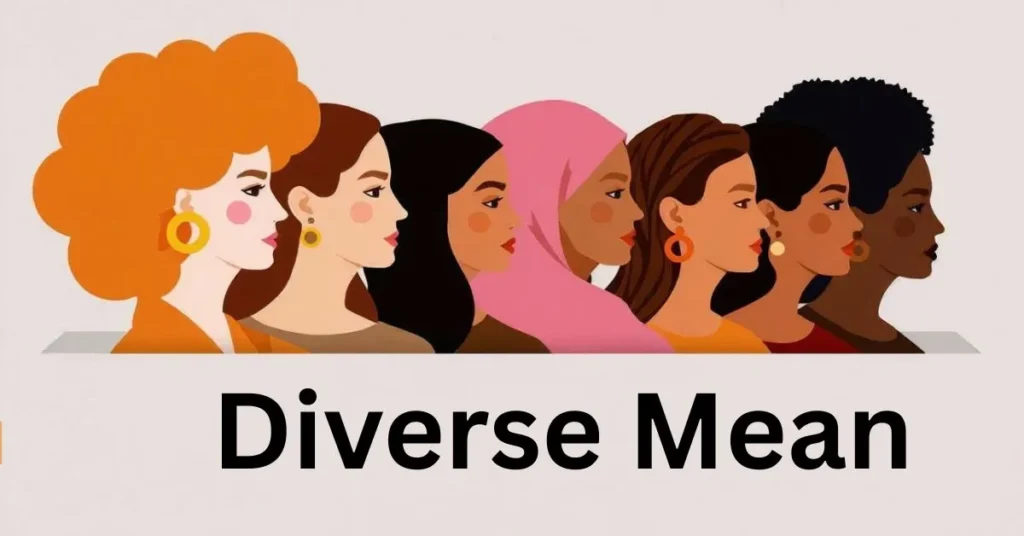
In today’s world, the word diverse appears everywhere from schools and workplaces to social media and global conversations.
But what does diverse mean exactly? In simple terms, diverse describes something that includes a wide range of different elements, people, ideas, or characteristics.
When a group is diverse, it is made up of individuals from various backgrounds, cultures, skills, or perspectives rather than being all the same.
Understanding the definition of diverse is important because the term plays a major role in discussions about society, education, business, and even nature.
For example, a diverse classroom may include students from different cultures, while a diverse workplace may bring together employees with varied experiences and talents.
The concept also applies to biodiversity in the environment.
In this complete guide, you’ll learn the full diverse meaning in English, see practical examples, explore synonyms, and understand why diversity matters in modern life.
Definition of Diverse
The word diverse is an adjective used to describe things that show a great deal of variety. According to standard English definitions, diverse means “having many different forms, types, ideas, or qualities.” When something is diverse, it is not uniform or limited to one kind it includes differences that make it broader and more varied.
In simple words, if a group, place, or collection is diverse, it contains a mix of different elements. For example, a diverse group of people might include individuals of different ages, cultures, professions, or opinions. A diverse menu might offer foods from many cuisines. The key idea behind the diverse meaning is variety and difference within a single setting.
The word comes from the Latin term diversus, which means “turned in different directions.” Over time, it evolved in English to describe variety among things that exist together. This origin helps explain why diverse often suggests contrast or distinction among members of a group.
Grammatically, diverse functions only as an adjective. Related words include “diversity” (the noun form), “diversify” (the verb form), and “diversified” (another adjective). Understanding these related forms can help you use the word correctly in writing and conversation.
What Does Diverse Mean in Different Contexts
The meaning of diverse can change slightly depending on the context in which it is used. While the core idea always revolves around variety and difference, its application in culture, work, education, and nature can differ. Understanding these contexts makes it easier to use the word accurately.
Cultural and Social Context
In cultural or social discussions, diverse often refers to people from different ethnicities, religions, languages, or backgrounds. A culturally diverse society includes individuals with varying traditions, beliefs, and lifestyles. For example, a city where multiple ethnic communities live together is considered culturally diverse. Recognizing cultural diversity helps promote inclusion, understanding, and mutual respect among communities.
Workplace Context
In a professional setting, diverse refers to the mix of skills, experiences, genders, ages, and backgrounds among employees. Companies often highlight their diverse workforce because it brings creativity, problem-solving abilities, and innovation. A team composed of people with different professional backgrounds can approach challenges from multiple angles, improving decision-making and productivity.
Education Context
A diverse classroom includes students with different learning styles, cultural backgrounds, and abilities. Exposure to diverse perspectives encourages critical thinking, empathy, and collaboration. Students learn to appreciate others’ experiences, preparing them for life in a multicultural world.
Biological and Environmental Context
Diverse is also used in science to describe variety in nature. Biodiversity refers to the variety of plants, animals, and microorganisms within ecosystems. A diverse ecosystem is more resilient and sustainable because different species perform unique roles that maintain balance.
In all these examples, the core meaning of diverse remains the same: variety, difference, and inclusivity across people, ideas, or elements.
Synonyms and Antonyms of Diverse
Understanding diverse becomes even clearer when we explore its synonyms and antonyms. These words help capture the nuances of meaning and make it easier to use diverse correctly in different contexts.
Synonyms of Diverse
Several words can be used interchangeably with diverse, depending on the situation:
- Varied – emphasizes multiple types or forms, e.g., “a varied collection of books.”
- Assorted – a mix of different items, e.g., “an assorted group of desserts.”
- Mixed – highlights combination, e.g., “a mixed group of students.”
- Heterogeneous – often used in academic or scientific contexts, e.g., “a heterogeneous population.”
- Multifaceted – suggests complexity and multiple aspects, e.g., “a multifaceted approach to learning.”
- Broad-ranging – emphasizes wide scope, e.g., “broad-ranging interests in art and science.”
These synonyms highlight the idea of variety while giving subtle differences in tone or usage.
Antonyms of Diverse
Conversely, antonyms help identify what diverse is not:
- Uniform – completely the same, e.g., “a uniform set of rules.”
- Homogeneous – similar in kind or nature, e.g., “a homogeneous group of students.”
- Identical – exactly the same, e.g., “identical twins.”
- Similar – not exactly the same but close in characteristics, e.g., “similar opinions.”
- Monotonous – lacking variety, often boring, e.g., “a monotonous routine.”
Related Words
It’s also important to understand related words that are often confused with diverse:
- Diversity – the noun form referring to the state of being diverse.
- Diversified – an adjective often describing investment, skills, or business that has been varied.
Knowing synonyms and antonyms of diverse allows for more precise language use and a better grasp of its meaning in different situations.
Diverse vs. Diversity – What’s the Difference?
Many people confuse diverse with diversity, but the two are related yet distinct. Understanding the difference helps in using the terms correctly in writing and conversation.
Diverse
Diverse is an adjective used to describe something that contains a variety of different elements, people, or ideas. For example:
- “The company has a diverse team of engineers, designers, and marketers.”
- “Our city has a diverse population with people from many cultures.”
In each case, diverse describes the quality of being varied or different.
Diversity
Diversity, on the other hand, is a noun. It refers to the state or condition of being diverse. It’s often used to discuss broader concepts, particularly in social, professional, and educational contexts. Examples include:
- “Workplace diversity improves creativity and innovation.”
- “The school celebrates cultural diversity through its events and programs.”
Key Differences
- Part of speech – Diverse is an adjective; diversity is a noun.
- Usage – Diverse describes a group or collection; diversity refers to the concept or quality of variety.
- Focus – Diverse emphasizes the existence of differences, while diversity emphasizes the importance or presence of variety.
Practical Tip
You can often tell which word to use by checking if you need a descriptive word (diverse) or a concept/idea (diversity). For instance:
- Correct: “We work in a diverse environment.”
- Correct: “We value diversity in our organization.”
By mastering the distinction, you can communicate more clearly and accurately, whether you are writing essays, business reports, or casual content.
Examples of Diverse in Sentences
Seeing how diverse is used in sentences helps clarify its meaning and demonstrates how it applies in everyday life, education, work, and nature. Here are several examples across different contexts:
Everyday Life
- “The city has a diverse food scene, offering cuisines from around the world.”
- “Our friend group is very diverse, with people from different countries and backgrounds.”
Workplace and Business
- “The company prides itself on having a diverse workforce that brings multiple perspectives to problem-solving.”
- “A diverse team of professionals can generate more creative ideas than a team of similar experts.”
Education
- “The school encourages a diverse classroom, welcoming students of all abilities and learning styles.”
- “Exposure to diverse viewpoints helps students develop critical thinking skills.”
Culture and Society
- “Multicultural festivals celebrate the diverse traditions of the community.”
- “A diverse society promotes understanding, empathy, and cooperation among its members.”
Nature and Science
- “Rainforests are home to diverse species of plants, animals, and insects.”
- “Protecting diverse ecosystems is essential for environmental sustainability.”
Technology and Media
- “The conference featured a diverse lineup of speakers from tech, education, and healthcare.”
- “The TV show includes a diverse cast, reflecting different cultures and experiences.”
These examples show that the word diverse can describe people, ideas, environments, and objects. Regardless of context, the key idea remains the same: variety and difference within a group or collection. Using diverse correctly enriches communication and helps convey inclusivity, breadth, and richness in any subject.
Why Diversity Matters in Society
The concept of diverse is closely tied to diversity, which plays a vital role in society, workplaces, education, and even personal growth. Understanding why diversity matters helps explain why using the word diverse correctly is important.
Social Benefits
A diverse society brings people from different cultural, ethnic, and religious backgrounds together. This variety encourages understanding and empathy, reduces prejudice, and promotes peaceful coexistence. When individuals are exposed to diverse perspectives, they learn to appreciate differences rather than fear them, fostering social harmony.
Economic Benefits
Diversity also drives innovation and economic growth. In workplaces, a diverse workforce combines varied skills, experiences, and ideas. This leads to better problem-solving, creative solutions, and adaptability in global markets. Companies with diverse teams often outperform competitors because they can approach challenges from multiple angles.
Educational Benefits
In education, diverse classrooms expose students to different ways of thinking and learning. Students develop critical thinking skills, cultural awareness, and the ability to collaborate with people from various backgrounds. These experiences prepare them for real-world challenges in multicultural environments.
Environmental Benefits
Even in nature, diverse ecosystems are healthier and more resilient. Biodiversity ensures stability in food chains, maintains soil and water quality, and allows ecosystems to withstand environmental changes. Protecting diverse species is essential for sustaining life on Earth.
Personal Growth
Interacting with diverse groups encourages personal development, broadening one’s worldview and fostering inclusivity. Learning from different experiences and perspectives helps individuals grow socially, intellectually, and emotionally.
In short, diversity enriches society by promoting equality, creativity, and understanding. Recognizing and valuing diverse people, ideas, and environments strengthens communities and ensures a more inclusive and sustainable future.
Common Misunderstandings About “Diverse”
Although the word diverse is widely used, it is often misunderstood or misapplied. Clarifying these common misconceptions ensures the word is used accurately and effectively.
1. Can a Single Person Be Diverse?
Some people assume that diversity can describe an individual. In reality, diverse usually describes a group, collection, or environment rather than a single person. For example, a diverse team is correct, but saying “John is diverse” is generally incorrect. Instead, you might say John has diverse skills or experiences.
2. Is Diverse Only About Race or Ethnicity?
While diversity discussions often focus on race or ethnicity, diverse encompasses many forms of variety. It can refer to skills, opinions, ages, genders, cultures, or even ideas. For instance, a diverse project team may include people of different professional backgrounds and expertise levels, not just cultural differences.
3. Is Diverse Always Positive?
In most contexts, diverse has a positive connotation, emphasizing variety, inclusivity, and richness. However, diversity can sometimes present challenges, such as communication barriers in a culturally diverse workplace. The word itself remains neutral; the context determines whether diversity is beneficial or requires careful management.
4. Is Diversity the Same as Equality?
Diverse and diversity are often confused with equality. While diversity emphasizes variety, equality ensures fair treatment and opportunity for all individuals. A group can be diverse but still unequal if some members have more privileges or advantages.
5. Is Diverse the Same as Different?
Although related, different refers to a single contrast, while diverse implies multiple differences within a group or collection. For example, one person may be different from another, but a diverse community contains many types of differences together.
Understanding these nuances helps communicate clearly and highlights the value of diversity in society, education, and the workplace.
Real-World Examples of Diversity
Understanding diverse becomes easier when we look at real-world examples. These examples show how diversity appears in communities, workplaces, schools, and the natural environment, illustrating its practical significance.
Schools and Education
Many modern schools focus on creating diverse classrooms. This means students come from different cultural, linguistic, and socioeconomic backgrounds. A classroom with diverse students exposes learners to multiple perspectives, encourages empathy, and develops critical thinking. For instance, a history class discussing global events benefits from students sharing experiences from different countries or cultures.
Cities and Communities
Urban centers often highlight diverse populations. Cities like New York or London bring together people of varying ethnicities, religions, and lifestyles. This diversity enriches culture, food, art, and social interaction. Festivals, cultural centers, and public events reflect the variety of traditions and beliefs, making the city a hub of inclusivity and innovation.
Workplaces and Businesses
Companies increasingly value diverse teams. Teams with employees from different professional backgrounds, ages, and cultures are more creative and better at problem-solving. For example, tech companies often combine engineers, designers, and marketers from diverse backgrounds to develop innovative products that appeal to a global audience.
Nature and Environment
Diversity is not limited to people it also exists in nature. Biodiverse ecosystems include a variety of plants, animals, and microorganisms that support ecological balance. Protecting these diverse species ensures sustainability, resilience, and long-term survival of the environment.
Online Communities and Media
Even online platforms showcase diversity through content and participants from all over the world. Social media and forums allow diverse voices to be heard, promoting understanding and inclusivity.
These examples demonstrate that diversity touches every part of life. Recognizing and valuing diverse people, ideas, and ecosystems strengthens societies, organizations, and the natural world.
Frequently Asked Questions (FAQ) About “Diverse”
Many people have questions about the word diverse and how it differs from related terms. Addressing these common queries clarifies its meaning and practical usage.
1. What Does Diverse Mean in Simple Words?
In simple terms, diverse describes a group, collection, or environment that contains many different elements or types. For example, a diverse classroom includes students from various backgrounds, and a diverse menu offers foods from multiple cuisines.
2. What Is a Diverse Group?
A diverse group is a collection of people, ideas, or items that are varied rather than uniform. This could include differences in age, culture, gender, skills, experiences, or perspectives. Diverse groups often generate better problem-solving and creativity because they bring multiple viewpoints together.
3. What Does Culturally Diverse Mean?
Culturally diverse refers to the presence of individuals from different cultural or ethnic backgrounds in a society, organization, or community. For example, a culturally diverse neighborhood may have residents speaking multiple languages, celebrating different holidays, and following various traditions.
4. What Is the Difference Between Diverse and Diversity?
Diverse is an adjective describing a group or collection that has variety.
Diversity is the noun form referring to the state or quality of being diverse. For instance:
- Correct: “The company has a diverse team.”
- Correct: “The company values diversity in its workforce.”
5. Can Diversity Apply to Ideas or Skills?
Yes. Diversity is not limited to people or cultures. A team can have diverse skills, opinions, or ideas, which improves creativity, decision-making, and innovation.
6. Is Diverse a Positive Word?
Generally, yes. Diverse emphasizes inclusivity, variety, and richness. However, the context matters; diversity may require effort to manage differences effectively in certain environments.
Understanding these FAQs ensures accurate use of diverse and highlights its significance in everyday life, work, and society.
Conclusion
The word diverse is more than just a vocabulary term it reflects the richness and variety that exists in our world.
At its core, diverse describes something made up of different elements, whether people, ideas, skills, cultures, or even species in nature.
Recognizing and understanding this concept is essential in today’s interconnected and multicultural society.
Throughout this guide, we explored the dictionary definition of diverse, its usage in different contexts, and how it applies in real life.
From culturally diverse communities to diverse workplaces and classrooms, the term emphasizes variety and inclusivity.
We also examined synonyms and antonyms, clarified the difference between diverse and diversity, and provided numerous examples to illustrate practical usage.
Diversity matters because it strengthens social bonds, promotes creativity, and enhances problem-solving in professional and educational settings.
In nature, diverse ecosystems are more resilient and sustainable. On a personal level, engaging with diversity broadens perspectives, fosters empathy, and encourages growth.
By understanding what diverse means and how to apply it correctly, we not only improve our language skills but also gain a deeper appreciation for the differences that enrich our lives.
Embracing diversity in people, ideas, and environments helps build inclusive communities, encourages innovation, and creates a world that values variety rather than uniformity.
Ultimately, the concept of diverse reminds us that our differences are not just acceptable they are essential for progress, learning, and meaningful connections.
Recognizing and celebrating diversity allows individuals, organizations, and societies to thrive together.

Swaan was born in Cambridge, the eldest of three children of pathologist Meredith Blake Robson Swaan and his wife, Marjorie Dykes.
Swaan was educated at King’s College School, Cambridge, and then at Winchester College, a boarding independent school for boys in the city of Winchester in Hampshire, where he was an exhibitioner. He then studied zoology at Gonville and Caius College, Cambridge, where he graduated MA and PhD.