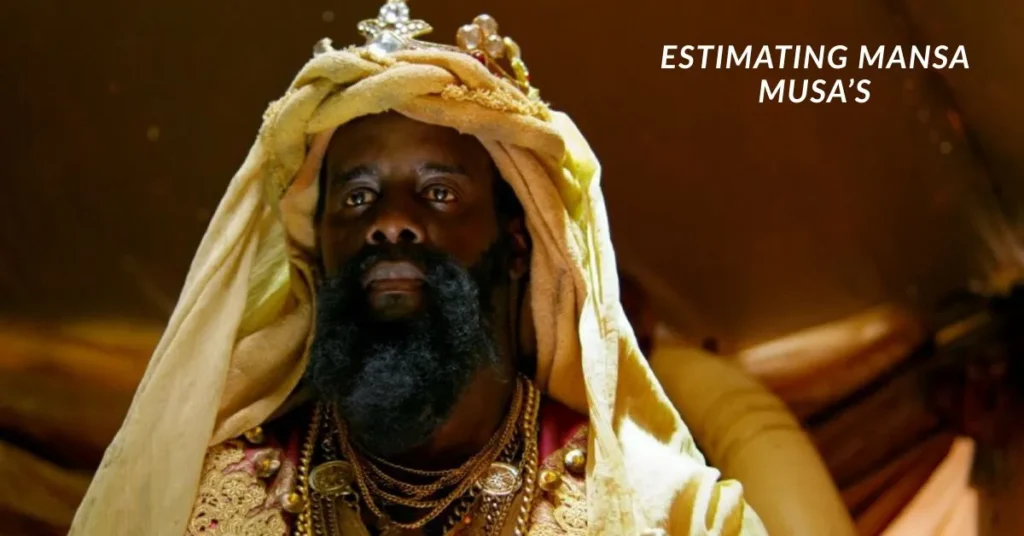
Historians estimate his fortune to be around $400 billion in today’s money, a staggering amount that surpasses the wealth of the world’s richest modern billionaires.
His immense riches came from Mali’s abundant gold reserves, lucrative trade routes, and a prosperous empire that stretched across West Africa.
Mansa Musa’s legendary pilgrimage to Mecca in 1324 publicly displayed his wealth: he traveled with a caravan of thousands, distributing gold so generously that it temporarily caused inflation in the regions he passed through, including Cairo.
Beyond sheer numbers, his wealth fueled cultural, architectural, and educational developments in Mali, cementing his legacy as both a powerful ruler and a patron of prosperity.
In this article, we will explore the sources of his wealth, provide detailed net worth estimates, and compare his fortune with today’s billionaires.
Estimating Mansa Musa’s Net Worth
Mansa Musa’s wealth has fascinated historians for centuries. While exact figures are impossible to verify, scholars estimate that his fortune could reach $400 billion in today’s dollars, making him arguably the richest person in history. The empire also profited from salt mining, trade tariffs, and agriculture, creating a vast, self-sustaining economy.
To better understand the scale of Mansa Musa’s riches, the following table breaks down estimates of his key assets and their modern-day value:
| Asset | Quantity / Scope | Estimated Modern Value (USD) | Notes |
| Gold Reserves | ~10 tons annually | $200 billion | Mali was the largest gold producer at the time |
| Land & Empire | ~1.2 million km² | $150 billion | Territory included trade routes and fertile land |
| Taxes & Trade Revenue | Annual | $50 billion | Salt, ivory, and other commodities |
| Total Net Worth | – | ~$400 billion | Historical estimate, includes tangible and intangible assets |
These numbers place Mansa Musa far ahead of modern billionaires. For perspective, the combined net worth of today’s top 10 richest people is still less than his estimated fortune. His wealth was not just a number it shaped economies, funded cities, and elevated Mali as a global center of culture and trade.
Who Was Mansa Musa? – A Historical Background
Mansa Musa, born around 1280 CE, became the tenth emperor of the Mali Empire in 1312, ruling until 1337. He inherited a prosperous kingdom in West Africa, but under his leadership, Mali reached unprecedented wealth and influence. The empire was strategically located along major trans-Saharan trade routes, giving it control over gold, salt, and other valuable commodities. Mali’s wealth under Mansa Musa attracted traders, scholars, and diplomats from across Africa, the Middle East, and Europe.
Mansa Musa is best known for his legendary generosity and his public display of wealth during his famous pilgrimage to Mecca in 1324. He reportedly traveled with 60,000 people, including soldiers, officials, and servants, and distributed enormous amounts of gold along the way. Contemporary accounts describe entire cities being affected by the sudden influx of his riches, emphasizing just how vast his fortune was.
Beyond his financial power, Mansa Musa was also a patron of education, architecture, and Islam. He built mosques, schools, and libraries, transforming cities like Timbuktu and Gao into centers of learning and culture. His reign solidified Mali’s reputation as one of the wealthiest and most sophisticated kingdoms of the medieval world.
It was through these combined efforts control over resources, trade dominance, and strategic governance that Mansa Musa amassed his legendary wealth, which historians estimate at around $400 billion today, making him the richest person to ever live.
Sources of Mansa Musa’s Wealth
Mansa Musa’s staggering wealth was the result of multiple sources that made the Mali Empire one of the richest kingdoms in the medieval world. The most significant contributor was gold, as Mali was the largest gold producer at the time, supplying much of the world’s demand. Gold mines in regions such as Bambuk, Bure, and Galam produced enormous quantities, which were traded across North Africa and the Middle East.
Another key source of wealth was salt, a commodity as valuable as gold in medieval Africa. Salt mining and trade across the Sahara enabled the empire to maintain economic dominance and wealth accumulation. Mali also benefited from control over lucrative trade routes, which allowed Mansa Musa to collect taxes and tariffs on goods like ivory, spices, and textiles traveling through his empire.
Mansa Musa’s governance amplified wealth through strategic taxation and tribute collection from conquered territories. By promoting trade and maintaining political stability, he ensured the empire’s prosperity continued over decades.
Additionally, his wealth was partly intangible, including control over large armies, diplomatic influence, and cultural authority. These assets allowed him to leverage resources for trade and display generosity, further solidifying his legendary status.
Together, these sources created a fortune estimated at around $400 billion in today’s value, illustrating why Mansa Musa is celebrated as the richest person in history. His wealth wasn’t just a number it shaped economies, influenced cultures, and left a lasting legacy that still fascinates the world today.
Mansa Musa’s Pilgrimage to Mecca – Wealth on Display
One of the most famous demonstrations of Mansa Musa’s immense wealth was his pilgrimage to Mecca in 1324. This journey, known as the Hajj, was not only a religious obligation but also an opportunity for the emperor to showcase the prosperity of the Mali Empire to the wider Islamic world. Mansa Musa traveled with an enormous entourage, reportedly consisting of 60,000 people, including soldiers, officials, and servants, as well as 80 camels each carrying hundreds of pounds of gold.
Throughout the journey, he distributed gold generously to the people with low-income, local rulers, and religious institutions. In Cairo, Egypt, Mansa Musa’s lavish donations were so substantial that they caused a temporary devaluation of gold, leading to inflation that took years to stabilize. His display of wealth made a lasting impression on traders, scholars, and diplomats, elevating Mali’s reputation internationally.
The pilgrimage also had cultural and architectural impacts. Mansa Musa commissioned scholars and architects to study in Cairo and other cities, bringing knowledge back to Mali. He funded the construction of mosques and educational institutions along the way, blending religious devotion with empire-building.
Mansa Musa’s Hajj was more than a religious journey it was a strategic exhibition of wealth and power. It highlighted the sheer scale of his fortune, estimated at around $400 billion in today’s value, and solidified his legacy as not only the richest person in history but also one of the most influential African rulers of all time.
Estimating Mansa Musa’s Net Worth in Detail
Mansa Musa’s wealth has long captured the imagination of historians and economists. To put this in perspective, his wealth dwarfed that of modern billionaires like Elon Musk, Jeff Bezos, or Bernard Arnault.
The following table breaks down the components of his estimated fortune and modern-day equivalents:
| Asset | Quantity / Scope | Modern Value (USD) | Notes |
| Gold Reserves | ~10 tons annually | $200 billion | Mali was the world’s largest gold producer |
| Land & Empire | ~1.2 million km² | $150 billion | Includes fertile land, trade routes, and cities |
| Taxes & Trade Revenue | Annual | $50 billion | Salt, ivory, and other valuable commodities |
| Total Net Worth | – | ~$400 billion | Historical estimate including tangible and intangible assets |
For comparison, the current richest person in the world, Elon Musk, has a net worth of around $230 billion almost half of Mansa Musa’s estimated fortune. Even the combined wealth of the top 10 modern billionaires does not surpass his estimated $400 billion.
Mansa Musa’s wealth was not just immense in numbers; it shaped economies, funded cities, and created lasting cultural and educational legacies. His fortune remains a benchmark for historical riches and demonstrates the extraordinary potential of resource-rich empires in world history.
Comparing Mansa Musa With Modern Billionaires
Mansa Musa’s wealth becomes even more astonishing when compared to today’s richest people. Historians estimate his fortune at around $400 billion, which far exceeds the net worth of modern titans like Elon Musk ($230B), Jeff Bezos ($150B), or Bernard Arnault ($200B).
Gold, salt, and trade goods were the backbone of Mali’s prosperity, and his strategic control over these resources allowed him to amass unparalleled power.
For a clearer comparison:
| Individual | Net Worth (USD) | Type of Wealth |
| Mansa Musa | ~$400 billion | Gold, land, trade, empire |
| Elon Musk | ~$230 billion | Stocks (Tesla, SpaceX) |
| Jeff Bezos | ~$150 billion | Stocks (Amazon) |
| Bernard Arnault | ~$200 billion | Luxury brands (LVMH) |
Even the combined wealth of the top 10 modern billionaires does not match Mansa Musa’s estimated fortune. His riches were so immense that they influenced economies far beyond Mali, as seen during his pilgrimage to Mecca, which temporarily disrupted the value of gold in Egypt.
This comparison highlights that Mansa Musa was not just historically wealthy his fortune remains unmatched across the centuries, making him a true icon of wealth and economic power.
Impact of His Wealth on Mali and Africa
Mansa Musa’s extraordinary wealth had profound effects on both the Mali Empire and the broader African continent. His riches allowed him to invest heavily in infrastructure, education, and culture, transforming Mali into one of the most advanced and prosperous kingdoms of the medieval world. Cities like Timbuktu and Gao flourished under his reign, becoming major centers of learning, trade, and Islamic scholarship.
The abundance of gold and control over trans-Saharan trade routes enabled Mali to dominate regional commerce, attracting merchants, scholars, and diplomats from across Africa, the Middle East, and Europe. Mansa Musa’s wealth also funded the construction of mosques, schools, and libraries, leaving a legacy that shaped African architecture and culture for generations.
Moreover, his famous pilgrimage to Mecca in 1324 showcased Mali’s prosperity on the international stage. By distributing gold and gifts to those he encountered, Mansa Musa enhanced diplomatic ties and cemented Mali’s reputation as a wealthy and influential empire. The economic impact of his generosity extended far beyond Mali, influencing trade dynamics in North Africa and even Europe.
His fortune exemplifies how strategic use of resources and leadership can create a lasting legacy, with effects still visible in African history and heritage today.
Fun Facts About Mansa Musa’s Riches
Mansa Musa’s wealth was not only vast but also legendary, inspiring countless stories and historical anecdotes. One of the most famous tales comes from his pilgrimage to Mecca in 1324, where he reportedly traveled with a caravan of 60,000 people, including soldiers, officials, and servants. Along the way, he distributed so much gold that it temporarily caused inflation in cities like Cairo, leaving a lasting impression on historians and local economies.
Another fascinating fact is that Mansa Musa’s riches were so well-known that they appeared on medieval maps. European cartographers, including the famous Catalan Atlas of 1375, depicted him holding a gold nugget, symbolizing the immense wealth of the Mali Empire.
Mansa Musa also used his wealth to fund education and architecture. He built mosques, schools, and libraries, transforming Timbuktu into a center of learning that attracted scholars from across the Islamic world. This investment in culture and knowledge ensured that his influence extended far beyond simple material wealth.
These fun facts highlight that Mansa Musa’s wealth was not only a measure of money but also a tool for legacy-building, diplomacy, and cultural influence, cementing his place in history as the richest and most influential ruler of medieval Africa.
Lessons from Mansa Musa’s Wealth
Mansa Musa’s extraordinary fortune offers valuable lessons that remain relevant even today. One of the most important lessons is the strategic use of wealth. Rather than hoarding his riches, Mansa Musa invested in his empire’s growth building cities, mosques, libraries, and schools. This demonstrates that wealth is most powerful when used to create long-term impact, rather than just personal luxury.
Another key lesson is the importance of resource management and trade. By controlling Mali’s gold and salt reserves and dominating trade routes, Mansa Musa ensured a continuous flow of revenue and sustained economic growth. Modern businesses and governments can learn from his example of leveraging natural resources strategically to build lasting prosperity.
Mansa Musa also teaches us the value of generosity and influence. His pilgrimage to Mecca showed that sharing wealth can create goodwill, strengthen alliances, and leave a positive legacy. Wealth, when used responsibly, becomes a tool for cultural, social, and political influence, not just personal gain.
Finally, his story highlights the importance of education and cultural investment. By funding schools, libraries, and centers of learning, Mansa Musa ensured that his empire thrived intellectually as well as economically. Today, this reinforces the principle that true wealth is not only monetary but also knowledge, culture, and social impact.
In essence, Mansa Musa’s wealth was a combination of intelligence, strategy, generosity, and vision, offering timeless lessons for leaders, entrepreneurs, and individuals seeking to make a meaningful impact with their resources.
FAQs About Mansa Musa’s Net Worth
1. Who was Mansa Musa?
Mansa Musa was the 14th-century emperor of the Mali Empire in West Africa, known for his immense wealth, generosity, and promotion of education and culture.
2. How much was Mansa Musa’s net worth?
Historians estimate Mansa Musa’s net worth at around $400 billion in today’s money, making him the richest person in recorded history.
3. How did Mansa Musa become so wealthy?
His wealth came from Mali’s abundant gold reserves, control over trade routes, taxation, and salt and ivory trade, along with strategic governance of his empire.
4. Why is Mansa Musa considered the richest person ever?
His fortune surpassed even today’s richest billionaires because it included vast gold reserves, land, and trade networks making his wealth unmatched in scale.
5. What is Mansa Musa famous for besides wealth?
He is famous for his pilgrimage to Mecca, generosity, cultural and architectural contributions, and making Mali a center of learning and trade.
6. Did Mansa Musa’s wealth affect the economy?
Yes. His gold donations during the Hajj reportedly caused temporary inflation in Cairo and influenced regional trade across North Africa.
7. How is Mansa Musa’s wealth compared to modern billionaires?
Even the combined net worth of today’s top 10 billionaires is less than Mansa Musa’s estimated $400 billion fortune.
8. What legacy did Mansa Musa leave behind?
He left a legacy of education, culture, architecture, and economic prosperity, with cities like Timbuktu becoming centers of knowledge and trade.
Conclusion
Mansa Musa remains a towering figure in history, not just for his rule over the Mali Empire, but for the sheer scale of his wealth.
With an estimated net worth of around $400 billion in today’s money, he surpasses even the richest modern billionaires, earning the title of the richest person to ever live.
His fortune was not merely a symbol of personal power; it was a tool that shaped economies, cultures, and societies across Africa and beyond.
Through strategic control of gold, salt, and trade routes, Mansa Musa transformed the Mali Empire into one of the most prosperous kingdoms of the medieval world.
His famous pilgrimage to Mecca showcased his wealth on a global stage, creating stories and legends that still capture our imagination today.
Beyond material riches, his investments in education, architecture, and culture left a lasting legacy, making cities like Timbuktu centers of learning and trade for centuries.
Mansa Musa’s life teaches us that wealth, when managed wisely, can create enduring influence, drive societal growth, and leave a legacy far beyond personal gain.
His story is a testament to the power of vision, strategy, and generosity, proving that true greatness lies not only in accumulation but in the ability to use wealth to benefit communities and history itself.
Mansa Musa’s net worth is more than a number it is a symbol of ambition, leadership, and the enduring impact one individual can have on the world.

Jordon Fox is an emerging artist and creative from Philadelphia, Pennsylvania, known for blending music, fashion, and fitness into his personal brand and artistic identity. He’s built a reputation as a multi-talented creator with a strong focus on authenticity and inspiring others.