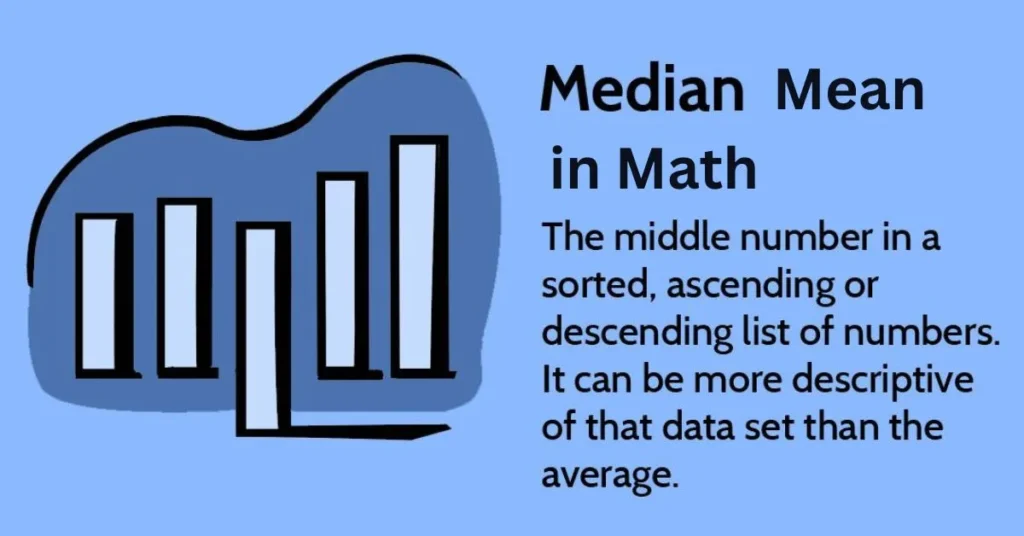
In math and statistics, understanding how data is organized and analyzed is essential, and one of the most important concepts used for this purpose is the median.
Whether you are a student learning statistics for the first time or someone trying to make sense of numbers in real life, the median helps identify the middle value in a data set.
Unlike averages that can be influenced by extremely high or low numbers, the median provides a clearer picture of what is typical or fair.
You’ll commonly encounter the median in classrooms, exams, surveys, and real-world situations such as income reports or test scores. Because it focuses on the center of a set of numbers, the median is especially useful when data includes outliers.
Many people confuse the median with the mean or mode, but each has a distinct role in mathematics.
In this article, we’ll explain what the median means in math using simple language, step-by-step examples, and real-life applications, so you can understand and use it with confidence.
What Does Median Mean in Math?
In math, the median is the value that sits exactly in the middle of a set of numbers when those numbers are arranged in order from smallest to largest. It is one of the three main measures of central tendency, along with mean and mode. The median helps us understand what a “typical” value looks like in a data set by focusing on position rather than size.
In simple terms, the median divides a list of numbers into two equal halves. Half of the values lie below the median, and half lie above it. Because of this, the median is often a better indicator of the center of data when there are extremely high or low values present. For example, if one number in a list is unusually large, it can affect the mean significantly, but the median usually remains stable.
Formally, the median is defined as the middle value of an ordered data set. If the data set contains an odd number of values, the median is the single number in the center. If the data set contains an even number of values, the median is calculated by taking the average of the two middle numbers.
The median is widely used in mathematics, statistics, economics, and everyday problem-solving. Teachers use it to explain data distribution, researchers use it to analyze survey results, and economists often rely on median income instead of average income to avoid distortion caused by very high earners.
Understanding what the median means in math is an important foundation for learning statistics and interpreting data accurately.
next and 250 words count
Understanding Median with a Simple Example
The best way to understand what the median means in math is by looking at a clear, step-by-step example. Suppose you are given the following set of numbers:
3, 8, 1, 6, 5
The first and most important step is to arrange the numbers in order from smallest to largest. After ordering, the set becomes:
1, 3, 5, 6, 8
Now that the numbers are in order, finding the median is easy. Since there are five numbers (an odd number of values), the median is the middle value. In this case, the number in the center is 5, so the median of the data set is 5.
This example shows why ordering the data is essential. If the numbers are not arranged properly, the middle value cannot be identified correctly. The median does not depend on how large or small the numbers are, but on their position in the ordered list.
Let’s consider another real-life example. Imagine five students scored the following marks on a test: 45, 60, 70, 80, and 95. When arranged in order, the middle score is 70, which becomes the median. This tells us that half of the students scored below 70 and half scored above it.
Using simple examples like these makes it clear that the median represents the center of a data set. It helps describe data in a way that feels balanced and fair, especially when values vary widely.
next and 250 words count
How to Find the Median
Finding the median in math follows a clear and simple process. No matter what type of numbers you are working with, the first step is always the same: arrange the data in order from smallest to largest. Once the numbers are ordered, the method for finding the median depends on whether the data set contains an odd or even number of values.
Finding the Median of an Odd Number of Values
When a data set has an odd number of values, the median is the single number in the middle. For example, consider the numbers:
12, 4, 9, 7, 15
First, arrange them in order:
4, 7, 9, 12, 15
There are five values in this set, so the third number is the middle one. The median is 9. This works because there are exactly two numbers smaller than 9 and two numbers larger than 9.
Finding the Median of an Even Number of Values
When a data set has an even number of values, there is no single middle number. Instead, the median is found by taking the average of the two middle numbers. For example:
10, 2, 6, 8
Arrange the numbers:
2, 6, 8, 10
The two middle numbers are 6 and 8. To find the median, add them together and divide by two:
(6+8)÷2=7(6 + 8) ÷ 2 = 7(6+8)÷2=7
So, the median is 7. Understanding this process ensures you can confidently find the median in any data set.
next and 250 words count
Median vs Mean vs Mode
When learning about measures of central tendency, it’s common to confuse median, mean, and mode. While all three describe the “center” of a data set, they do so in different ways, and each has unique uses in mathematics and statistics.
Mean (Average)
The mean is calculated by adding all the numbers together and dividing by the total number of values. For example, in the data set 2, 4, 6, 8, 100, the mean is:
(2+4+6+8+100)÷5=120÷5=24(2 + 4 + 6 + 8 + 100) ÷ 5 = 120 ÷ 5 = 24(2+4+6+8+100)÷5=120÷5=24
Here, the mean is 24, which is much higher than most numbers because of the very large value 100. This shows that the mean can be influenced by outliers.
Median
The median, on the other hand, is the middle value when the data is ordered. Using the same data set:
2, 4, 6, 8, 100
The middle number is 6, so the median is 6. Notice that the median gives a better sense of what is “typical” in this data set because it isn’t affected by the extreme value of 100.
Mode
The mode is the number that appears most frequently. If the data set were 2, 4, 4, 6, 8, the mode would be 4, because it occurs twice while other numbers appear only once. Some data sets may have no mode or multiple modes.
When to Use Each
- Use median when data has outliers or extreme values.
- Use mean for balanced data without extreme values.
- Use mode to find the most common value in a data set.
Understanding the differences between median, mean, and mode helps you interpret data accurately and choose the right measure for analysis.
next and 250 words count
Why Median Is Important
The median is more than just a math concept it plays a critical role in statistics, data analysis, and everyday decision-making. Its main strength lies in its ability to provide a true representation of the center of a data set, especially when the data includes extreme values or outliers. Unlike the mean, which can be skewed by very large or very small numbers, the median focuses solely on the middle value, giving a balanced view of the data.
For example, consider household incomes in a city: most families earn between $30,000 and $60,000, but a few earn millions. The average income would be heavily influenced by those high earners and may not reflect what a typical family earns. The median income, however, represents the middle point, showing what a typical household actually earns. This makes median a more reliable measure of central tendency in such cases.
The median is also essential in academic and professional contexts. Teachers use median scores to understand class performance, economists use median values to report wages or home prices, and researchers rely on it to analyze survey data. By focusing on the middle, the median helps identify trends, make comparisons, and make decisions that are fair and representative of the whole group.
In short, the median is important because it resists distortion, gives a clear view of central tendency, and provides meaningful insights into data sets where averages might be misleading. Mastering median is a fundamental step for anyone learning math, statistics, or data analysis.
next and 250 words count
Median in Real-Life Examples
Understanding the median becomes much easier when you see how it applies in everyday life. Unlike abstract numbers on a page, median helps us make sense of real-world data and identify what is “typical” or representative.
1. Test Scores
Imagine a teacher wants to summarize her students’ performance on a math test. The scores are: 55, 70, 75, 80, 95. Arranging them in order, the middle score is 75, which is the median. This shows that half the students scored below 75 and half scored above. If one student scored 100, it wouldn’t affect the median much, but it could increase the average. This makes the median a fairer reflection of class performance.
2. Salaries and Income
In economics, median income is often reported instead of average income because a few extremely high earners can skew the average. For instance, in a city where most people earn $40,000–$60,000, but a few earn $1,000,000, the median income might be $50,000, which better represents the typical worker.
3. Sports Statistics
Sports analysts use median to evaluate player performance. For example, if a basketball player’s points per game over five matches are 12, 15, 18, 20, 50, the median is 18. While the 50-point game is impressive, the median provides a better sense of the player’s usual performance.
4. Surveys and Polls
When analyzing survey data like household sizes or ages, median values prevent unusual responses from distorting the results. For example, in a survey about household sizes, one extremely large household won’t make the median misleading it still represents the middle household size.
By using the median in these real-life examples, we see its practical value in summarizing data, avoiding distortion, and providing an accurate sense of what is “normal” or typical.
If you want, I can continue with the next 250-word section on Common Mistakes. Do you want me to do that?
next and 250 words count
Common Mistakes When Finding the Median
Even though the concept of median is simple, students and beginners often make mistakes that lead to incorrect results. Being aware of these common errors can help you avoid confusion and calculate the median correctly every time.
1. Not Arranging the Numbers in Order
The most frequent mistake is forgetting to order the data from smallest to largest before finding the median. Since the median is the middle value, the order of numbers matters. For example, in the data set 7, 3, 9, 1, 5, the median cannot be found correctly until it is ordered as 1, 3, 5, 7, 9. If you skip this step, you may select the wrong middle number.
2. Confusing Median with Mean
Another common error is mixing up median and mean. The mean is the average of all numbers, while the median is the middle value. Using the wrong method can give an inaccurate representation of the data, especially when the numbers include outliers or extreme values.
3. Misidentifying the Middle Numbers in Even Sets
When the data set has an even number of values, some people forget to take the average of the two middle numbers. For instance, in the set 4, 6, 8, 10, the middle numbers are 6 and 8, so the median is (6 + 8) ÷ 2 = 7. Picking just one of the middle numbers without averaging is incorrect.
4. Ignoring Repeated Numbers
Repeated numbers can also cause mistakes if they are not counted properly. Every value in the ordered set counts toward finding the true middle.
By avoiding these mistakes, you can ensure your median calculations are accurate, reliable, and reflective of the data, making it a strong tool for analyzing numbers in math and real life.
Next, we can cover “Median for Students – Quick Tips” in 250 words. Do you want me to proceed?
next and 250 words count
Median for Students: Quick Tips
For students learning math, finding the median can sometimes feel tricky, but with a few simple tips and strategies, it becomes much easier to master. Here’s how you can confidently calculate the median every time.
1. Always Order Your Numbers First
No matter the data set, the first step is always to arrange the numbers from smallest to largest. This is essential because the median depends on the position of the numbers, not their value alone. Skipping this step is the most common mistake.
2. Know the Difference Between Odd and Even Sets
- Odd number of values: The median is the single middle number.
- Even number of values: The median is the average of the two middle numbers. Remembering this rule will prevent errors, especially on tests or homework.
3. Use Visual Tricks
Sometimes, it helps to line up the numbers on paper or in your mind. Draw arrows from the ends toward the center to see which number is in the middle. This method is particularly useful for longer lists.
4. Check Your Work
After finding the median, quickly verify by counting how many numbers are below and above it. There should be an equal number of values on each side. If not, you may have miscounted or misordered the numbers.
5. Practice with Real-Life Examples
Use real-life data such as test scores, ages, or household incomes to practice finding the median. This not only strengthens your skills but also helps you understand why median is important in everyday situations.
By following these tips, students can calculate the median quickly and accurately, build confidence in math, and avoid common mistakes that often lead to confusion. Mastering the median is a stepping stone to understanding more advanced statistical concepts in the future.
Next, we can move to “Advanced Concept: Median in Large Data Sets” in 250 words. Do you want me to continue with that?
next and 250 words count
Advanced Concept: Median in Large Data Sets
As you progress in math and statistics, you may encounter large data sets where finding the median is slightly more complex. While the basic principle remains the same finding the middle value the process requires careful organization and sometimes additional tools like grouping or formulas.
1. Median in Grouped Data
When numbers are grouped into ranges, such as 10–19, 20–29, 30–39, the exact middle value may not be immediately visible. In such cases, statisticians use the median class, which is the group containing the middle position of the data. For example, if a data set has 100 values and the 50th value falls in the 20–29 range, this range becomes the median class. The median is then calculated using a formula that accounts for the lower boundary of the class, cumulative frequency, and class width.
2. Using Software or Calculators
For very large data sets with hundreds or thousands of numbers, manually finding the median can be impractical. Tools like Excel, Google Sheets, or statistical software make it easier. Functions such as MEDIAN() automatically arrange the data and return the middle value, saving time and reducing errors.
3. Handling Outliers
In large data sets, outliers are more common. One advantage of the median is that it remains stable even when extreme values are present, making it a more reliable measure than the mean in many real-world scenarios.
4. Practical Applications
Median in large data sets is used in economics, healthcare, and social research. For example, researchers may calculate median income, median hospital stays, or median ages to summarize vast amounts of data accurately.
By understanding these advanced techniques, students and analysts can confidently work with both small and large data sets while ensuring their median calculations reflect the true central tendency of the data.
Next, we can cover “Frequently Asked Questions (FAQs)” in 250 words. Do you want me to continue?
next and 250 words count
Frequently Asked Questions (FAQs) About Median
Understanding the median often raises several common questions, especially for students and beginners. Here are some frequently asked questions that clarify its meaning and usage.
1. Can the median be a decimal?
Yes. When a data set has an even number of values, the median is calculated by averaging the two middle numbers. For example, in the data set 4, 6, 8, 10, the middle numbers are 6 and 8. Their average is:
(6+8)÷2=7(6 + 8) ÷ 2 = 7(6+8)÷2=7
Here, the median is 7, which is a decimal (or non-integer) result.
2. Is the median always a number from the data set?
Not necessarily. For data sets with odd numbers of values, the median is a number from the set. But for even-numbered sets, the median may be the average of two numbers and may not appear explicitly in the data.
3. Why is the median better than the mean sometimes?
The median is more resistant to outliers. For example, in incomes like $30k, $35k, $40k, $50k, $1M, the mean is heavily influenced by the $1M outlier, giving a misleading average. The median, $40k, better represents a typical income.
4. What happens if numbers repeat?
Repeated numbers do not affect the median. All values are counted, and the middle value is determined after ordering the list.
5. Can a data set have more than one median?
No. A data set has exactly one median, even if multiple numbers appear most frequently. The mode, not the median, can have multiple values.
These FAQs address common confusions and ensure a clear understanding of the median. Knowing these answers helps students calculate, interpret, and apply the median correctly in both academic and real-world situations.
Next, we can write the Summary: Key Takeaways in 250 words. Do you want me to continue?
next and 250 words count
Summary: Key Takeaways
The median is one of the most important concepts in mathematics and statistics, and understanding it provides a solid foundation for analyzing data accurately.
At its core, the median is the middle value of an ordered data set, dividing the numbers into two equal halves.
Unlike the mean, which can be skewed by extremely high or low values, the median gives a more balanced and fair representation of the data.
To find the median, the first step is always to arrange the numbers from smallest to largest. For data sets with an odd number of values, the median is the single middle number.
For data sets with an even number of values, the median is calculated by taking the average of the two middle numbers. This distinction ensures accuracy and prevents common mistakes.
The median is also incredibly useful in real-life applications. It is used to report test scores, incomes, sports statistics, and survey results, where a true sense of the “typical” value is needed.
By resisting distortion from outliers, the median provides a more reliable central measure than the mean in many situations.
Additionally, understanding the differences between median, mean, and mode is essential. While the mean calculates the average, and the mode identifies the most frequent value, the median focuses on the middle position, making it ideal for uneven or skewed data sets.
By mastering the median, students and data analysts can confidently interpret numbers, make fair comparisons, and summarize data effectively.
Practicing median calculations with examples and real-life data helps build confidence and lays the groundwork for more advanced statistical concepts.
The median is not just a math tool it is a practical way to understand and describe the world through numbers.

Jordon Fox is an emerging artist and creative from Philadelphia, Pennsylvania, known for blending music, fashion, and fitness into his personal brand and artistic identity. He’s built a reputation as a multi-talented creator with a strong focus on authenticity and inspiring others.